

AI Agents: How They Transform Business Automation in 2026
Explore how AI agents are transforming businesses through automation, autonomous decision-making, and seamless integrations. Discover their benefits, real-world applications, and how custom AI agents help businesses improve efficiency and scale.
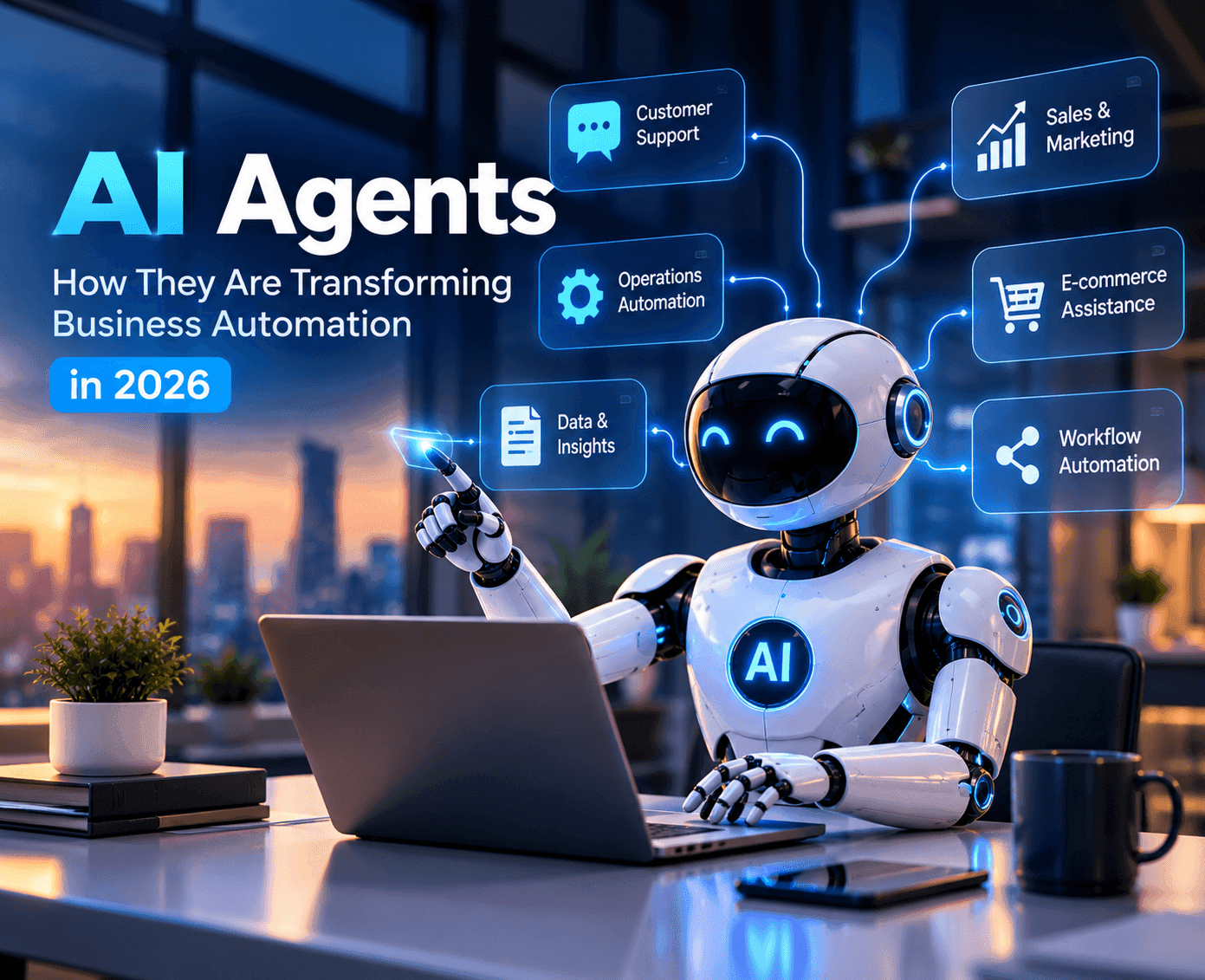
AI Agents: How They Are Transforming Business Automation in 2026
Artificial Intelligence is changing how businesses operate, manage workflows, interact with customers, and make decisions. Among the most significant developments in this transformation are AI agents. Unlike traditional automation tools that follow predefined instructions, AI agents can understand objectives, analyze information, make decisions, and perform tasks with varying degrees of autonomy.
From automating customer support and managing sales operations to processing business data and streamlining e-commerce activities, AI agents are becoming an important part of modern business infrastructure.
Businesses are increasingly exploring AI agent development to reduce repetitive work, improve operational efficiency, and deliver better customer experiences. With advancements in large language models (LLMs), machine learning, and API integrations, AI agents can now perform complex, multi-step business operations.
In this guide, we will explore what AI agents are, how they work, their benefits, practical applications, and how businesses can implement custom AI agents to improve productivity.
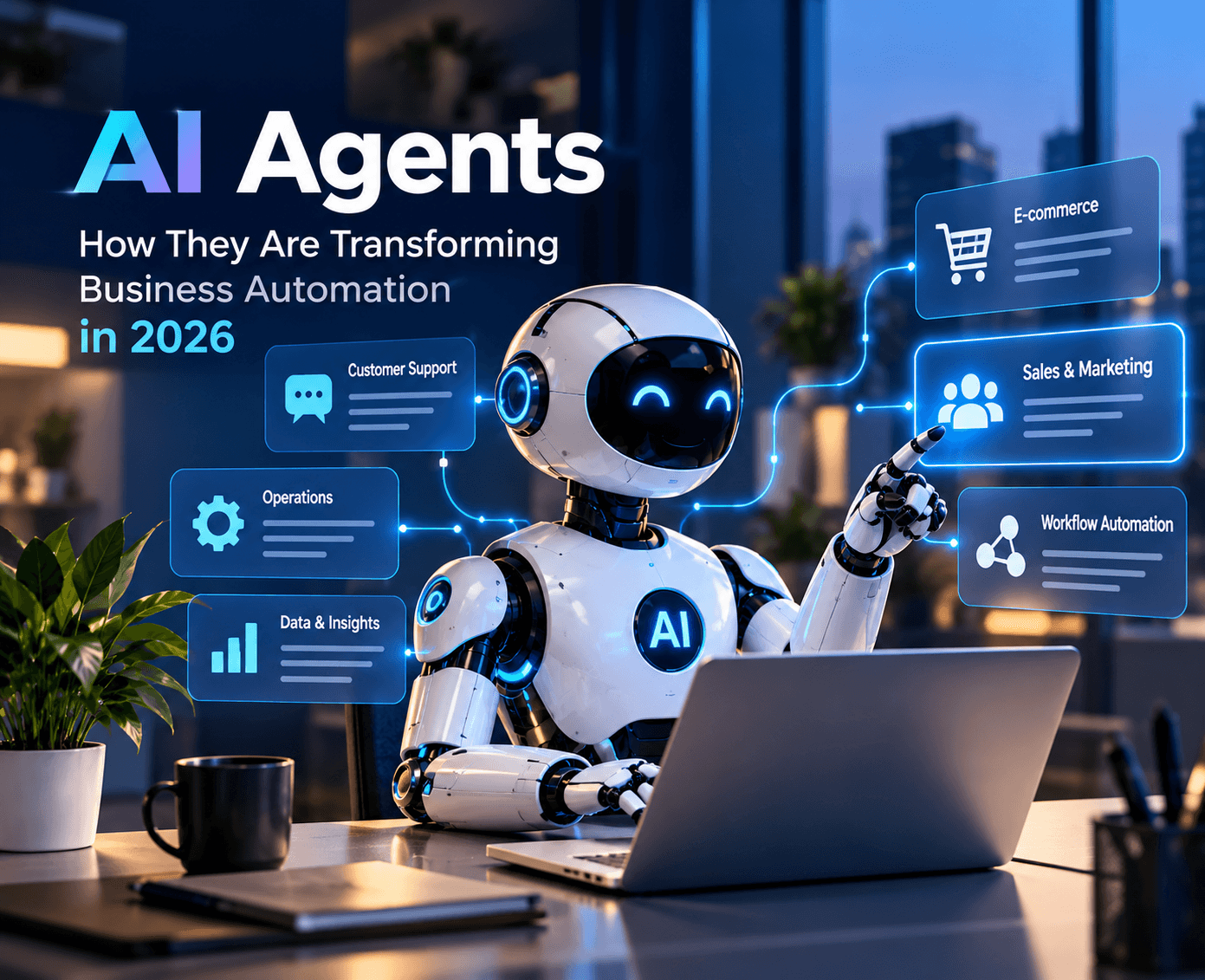
What Are AI Agents?
AI agents are intelligent software systems designed to perceive information, understand objectives, make decisions, and perform actions to achieve specific goals.
Unlike conventional software applications that require users to provide instructions for every operation, AI agents can independently handle multiple steps within a defined workflow.
For example, an AI customer support agent can:
Understand customer questions using natural language processing.
Retrieve relevant information from a knowledge base.
Identify the customer's problem.
Generate an appropriate response.
Update customer records through connected systems.
Escalate complex queries to human support representatives.
These capabilities make AI agents useful for businesses looking to automate repetitive operations while maintaining flexibility in their workflows.
How Do AI Agents Work?
AI agents combine multiple technologies to understand tasks, process information, and execute actions.
A typical AI agent architecture includes the following components:
1. Input and Perception
The agent receives information through text, voice, documents, APIs, databases, or other connected systems.
For example, an e-commerce AI agent may receive a customer query about an order or product.
2. Reasoning and Decision-Making
Using large language models and reasoning capabilities, the AI agent understands the request, evaluates available information, and determines the next action.
3. Memory and Context
AI agents can use conversation history, databases, and external knowledge sources to maintain context and provide more relevant responses.
4. Tools and Integrations
Agents can connect with business applications, APIs, CRM platforms, ERP systems, payment services, and other software to perform real-world operations.
5. Action and Execution
After determining the appropriate action, the agent executes the task, verifies the outcome where possible, and continues the workflow or requests human assistance.
AI Agents vs Traditional Automation
Traditional automation and AI agents both help businesses reduce manual work, but their approaches are different.
Feature | Traditional Automation | AI Agents |
|---|---|---|
Decision-making | Rule-based | Context-aware |
Flexibility | Limited | More adaptable |
Input handling | Structured inputs | Structured and unstructured inputs |
Workflow | Predefined | Can adapt to objectives |
Learning | Requires manual updates | Can use feedback and updated context |
Integration | Rule-based connections | Tool and API-based interactions |
Complexity | Best for repetitive tasks | Suitable for multi-step tasks |
Traditional automation remains useful for predictable processes. AI agents are particularly valuable when tasks involve changing inputs, contextual understanding, and multiple decision points.
Types of AI Agents Used in Business
Different types of AI agents can serve different operational requirements.
1. Customer Support AI Agents
Customer support agents handle customer questions, order updates, troubleshooting, and support requests.
They can operate across websites, messaging platforms, and other communication channels.
2. Sales AI Agents
Sales agents can qualify leads, research prospects, prepare follow-up messages, update CRM records, and assist sales teams.
3. E-commerce AI Agents
E-commerce agents help customers discover products, compare specifications, receive recommendations, and track orders.
They can also assist internal teams with product information and catalogue management.
4. Research AI Agents
Research agents gather information, analyze documents, summarize findings, and prepare reports based on defined objectives.
5. Workflow Automation Agents
These agents coordinate multiple business applications to automate processes such as document processing, data synchronization, approvals, and notifications.
6. Enterprise AI Agents
Enterprise agents can support complex workflows across departments by connecting internal databases, enterprise applications, and knowledge systems.
Benefits of AI Agents for Businesses
Implementing AI agents can provide several operational and strategic advantages.
1. Improved Operational Efficiency
AI agents can handle repetitive tasks and multi-step workflows, allowing employees to focus on activities that require human judgment and creativity.
2. Faster Customer Support
AI-powered customer support agents can respond to common questions, retrieve relevant information, and assist customers beyond traditional business hours.
3. Reduced Manual Work
Automating repetitive processes reduces the need for employees to perform the same tasks manually across multiple applications.
4. Better Business Productivity
AI agents can help teams manage information, coordinate workflows, and complete routine operations more efficiently.
5. Scalable Business Operations
Businesses can expand automated workflows as operational requirements grow without increasing manual effort at the same rate.
6. Improved Data Management
When connected to business systems, AI agents can retrieve, organize, validate, and update information across different platforms.
Real-World Applications of AI Agents Across Industries
AI agents are not limited to technology companies. They can support a wide range of industries.
E-commerce
Personalized product recommendations.
Automated order tracking.
Customer query resolution.
Product catalogue enrichment.
Shopping assistance.
Inventory-related workflow automation.
Education
Student admission assistance.
Automated enquiry management.
Course recommendations.
Student support.
Administrative workflow automation.
Hospitality
Hotel booking assistance.
Guest query management.
Reservation support.
Personalized travel recommendations.
Automated customer communication.
Manufacturing
Production workflow monitoring.
Maintenance assistance.
Inventory information retrieval.
Quality documentation.
Supply chain coordination.
Healthcare
Appointment scheduling.
Administrative support.
Patient enquiry management.
Medical document organization.
Healthcare implementations require appropriate privacy controls and human oversight, particularly for clinical decisions.
How AI Agents Integrate with Existing Business Systems
One of the biggest advantages of AI agent development is the ability to connect intelligent systems with existing business infrastructure.
AI agents can integrate with:
CRM platforms for customer and lead management.
ERP systems for enterprise operations.
E-commerce platforms for orders and product information.
CMS platforms for content management.
PIM systems for product data management.
Communication platforms for customer interactions.
Internal databases for information retrieval.
For example, an AI sales agent connected to a CRM can identify new leads, retrieve customer information, prepare follow-up recommendations, and update lead records.
These integrations make AI agents more useful than standalone chatbots because they can interact with actual business processes.
What Is Custom AI Agent Development?
Custom AI agent development involves designing intelligent software systems around an organization's specific workflows, business objectives, data, and technology infrastructure.
Unlike generic AI tools, custom agents can be configured to work with existing applications and business rules.
A typical AI agent development process includes:
Requirement Analysis: Identify repetitive processes, business challenges, and automation opportunities.
Architecture Planning: Define the agent's responsibilities, reasoning model, memory, and tools.
AI Model Selection: Select suitable LLMs and supporting AI technologies.
Integration Development: Connect the agent with databases, APIs, and business applications.
Testing and Validation: Evaluate response accuracy, task completion, security, and reliability.
Deployment and Monitoring: Deploy the agent and continuously monitor its performance.
Businesses should also establish access controls, approval workflows, audit logs, and human escalation mechanisms.
Challenges of Implementing AI Agents
Although AI agents offer significant opportunities, businesses should consider certain challenges before implementation.
Data Quality: Inaccurate or incomplete information can affect agent responses.
Security: Access to sensitive business systems requires proper permissions.
Reliability: AI-generated decisions should be validated for important operations.
Integration Complexity: Connecting multiple applications can require significant development work.
Cost Management: Model usage, infrastructure, and ongoing maintenance need to be considered.
Human Oversight: High-impact decisions and sensitive operations should have appropriate human approval.
A well-designed AI agent architecture should balance autonomy, reliability, security, and operational control.
The Future of AI Agents in Business Automation
AI agents are evolving from simple conversational assistants into systems capable of coordinating complex business workflows.
Future developments are likely to focus on multi-agent collaboration, improved reasoning, multimodal interactions, stronger enterprise integrations, and better contextual understanding.
Businesses may increasingly use specialized agents working together. For example, an e-commerce business could use one agent for customer support, another for product information, and another for order management.
These agents can coordinate through shared workflows while operating under defined business rules and permissions.
The goal is not necessarily to replace employees but to create more efficient business environments where people and intelligent systems work together.
Why Choose OEX Tech for AI Agent Development?
OEX Tech helps businesses explore AI-driven transformation through intelligent automation, custom integrations, and modern technology solutions.
Its approach focuses on connecting AI capabilities with real business requirements rather than implementing disconnected AI tools.
Through its AI and engineering ecosystem, OEX Tech can help businesses explore:
Custom AI agent development.
Conversational AI solutions.
AI-powered business automation.
E-commerce AI integrations.
Product information automation.
API and enterprise system integrations.
AI-ready digital infrastructure.
Whether you want to automate customer support, improve internal operations, or build intelligent e-commerce experiences, the right AI agent architecture can help create more scalable business processes.
Ready to explore AI agents for your business? Connect with OEX Tech to discuss your automation requirements and identify opportunities for intelligent business transformation.